

Rivers United scored 10 goals in their first 13 matches of the 2025/26 Nigeria Premier Football League, NPFL season. They have scored 22 at the same stage this time around.
It is a significant improvement for a side that finished last season as runners-up, just one point behind champions Rangers Int’l. Their attacking output has more than doubled, while their defensive record remains the best in the division, with just six goals conceded after 13 matches.
Only one team has scored more goals, Rangers with 23. No team has conceded fewer than Rivers United, with Barau FC (10) next on the list despite having played a game more.
Last season, Rivers United finished with 44 goals scored and 31 conceded from 38 matches, collecting 67 points. Rangers won the title with 47 goals scored and 27 conceded.
The gap between the two sides was not particularly wide. Rivers United scored three fewer goals and conceded four more, but those differences, alongside a couple of points dropped during the campaign, meant they had to settle for second place.
They also deserve some credit for their run in the CAF Champions League, which resulted in several of their league fixtures being rescheduled. The fact that the title race went down to the final day, and the manner in which they narrowly lost out, showed just how strong a side they were. Had they won the league, it would certainly have been a deserved achievement.
This season, they have started scoring at a rate that could take them well beyond last season’s total. The question is whether they can maintain that output, keep their defensive organisation and, most importantly, turn enough of their draws into victories to go one better.
Rivers United different attacking output
The difference between Rivers United’s attacking numbers across the two campaigns is difficult to overlook.
After 13 matches last season, they had scored 10 goals, averaging 0.77 per game. This season, that figure has risen to 1.69 goals per match, with their 22 goals representing a 120 per cent increase on their return at the same stage last year.
They are also just one goal behind the league’s leading attack. For a team that scored 44 goals throughout the entirety of last season, this represents a considerable change in productivity.
There is a possibility that Rivers United could finish this campaign with more than 60 league goals. Maintaining their current scoring rate across 38 matches would give them approximately 64, some 20 more than their previous campaign.
That is a sizable improvement, particularly when compared with the 47 goals scored by Rangers on their way to last season’s championship.
However, the distribution of those goals raises another question about Rivers United’s ability to sustain their challenge.
Of their 22 goals, 18 have come at home. They have scored just four away from Port Harcourt, despite playing six matches on the road.
This is not necessarily a problem with their overall attacking quality, but it does reveal a difference in their ability to impose themselves depending on where they play. At home, they have been considerably more productive. Away from home, their attacking output has not been enough to deliver a single victory.
For a team hoping to win the league, that is an area that requires attention.
Rivers United’s defensive consistency
Rivers United’s defensive record has been just as important as their attacking improvement.
They have conceded six goals in 13 matches, the fewest in the league. The next-best defensive record belongs to a team that has conceded 10.
Their average of 0.46 goals conceded per game is particularly impressive. It means they are conceding fewer than one goal every two matches, a return that gives them a strong platform in a league where keeping clean sheets can be just as valuable as scoring.
They have also recorded eight clean sheets in their opening 13 matches.
The home record is particularly striking. Rivers United have conceded just once in seven home matches, keeping six clean sheets. Away from home, they have conceded five times in six matches and kept two clean sheets.
The difference between the two records is worth examining. Their home performances suggest a side that is difficult to break down, while the five goals conceded away from home indicate that they have been more vulnerable on their travels.
Even so, six goals conceded overall is an excellent return.
There is an interesting comparison with last season. Rivers United had conceded four goals after their first 13 matches, two fewer than their current tally. Their present defensive record is therefore not better than it was at the same stage of the previous campaign.
But their current position relative to the rest of the league remains impressive.
They finished last season having conceded 31 goals in 38 matches, with only champions Rangers and Barau FC recording a better defensive return of 27 and 30 respectively. If they maintain their current rate, Rivers United would finish this campaign with approximately 18 goals conceded.
That would be a reduction of 13 goals on last season’s tally and nine fewer than Rangers managed during their title-winning campaign.
It is an ambitious projection, but it shows the level of defensive consistency Rivers United have established in the opening part of this season.
The home advantage and the away problem
Perhaps the most revealing aspect of Rivers United’s campaign so far is the contrast between their results at home and away.
They have won five of their seven home matches, drawn twice and remain unbeaten at the Adokiye Aimesimaka Stadium. Their away record, however, tells a different story. Six matches have produced five draws and one defeat, without a single victory.
The difference is reflected in their points return. They have collected 17 points from seven home matches, averaging 2.43 points per game. Away from home, they have managed just 5 points from six matches, an average of 0.83.
That is a considerable gap.
A team sometimes cannot reasonably expect to win the NPFL by relying almost entirely on its home performances, especially when the rivals are doing well on that front. The league’s long schedule demands that contenders find ways to collect points in difficult away fixtures, even when winning is not always possible.
Rivers United have shown that they can avoid defeat on the road, losing only once in six matches. But five draws also mean they have repeatedly left away grounds without the three points that could have brought them closer to the top.
Their overall record of five wins, seven draws and one defeat is a reflection of that problem.
The seven draws account for more than half of their matches, and while their solitary defeat demonstrates how difficult they are to beat, the number of shared points is most likely a concern for a team with title ambitions.
Their attacking improvement should, in theory, give them more opportunities to turn those draws into victories. However, their four away goals suggest that this has not happened consistently enough.
Finding a way to carry their home attacking confidence into away fixtures could be one of the most important developments in the remainder of their season.
What the numbers project
A projection based on Rivers United’s current performance offers an interesting comparison with their previous campaign.
If they maintain their present scoring and defensive rates across a 38-match season, they would finish with approximately 64 goals scored and 18 conceded.
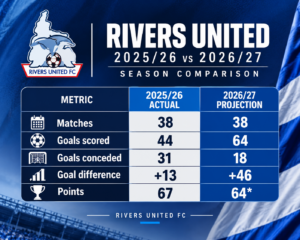
The projected points total is based on their current points-per-game average.
The projected goal difference of +46 would be a substantial improvement on the +13 they recorded last season. It would also be considerably better than Rangers’ +20 in their title-winning campaign.
However, the points projection offers a necessary reality check.
Rivers United have collected 22 points from 13 matches, averaging approximately 1.69 points per game. If that rate continues, they would finish with around 64 points, three fewer than the 67 they managed last season.
There is a clear difference between the two projections. Their goalscoring and defensive figures suggest a team capable of producing a much stronger campaign, but their points return does not yet reflect that improvement.
This is why their draws deserve so much attention. Goals and goal difference can provide an indication of a team’s strength, but the title is ultimately decided by the points collected.
Rivers United must ensure that their impressive performances are reflected more consistently in the league table.
Rivers United still have ground to make up in the title race
Rivers United’s 6-0 victory over Niger Tornadoes on Matchday 14 was an important result, particularly given the run that preceded it.
The Port Harcourt side had gone five league matches without a victory before that emphatic win, which included a second-half hat-trick from substitute Samson Olasupo.
The result moved them to 22 points, six behind leaders Rangers International, with a game in hand. It also provided a timely reminder of the attacking quality they possess.
There is still a considerable amount of football to be played, and the gap to the top is not beyond reach. In fact, nobody wins the title at this stage of the season But Rivers United will need to build on that victory rather than allow it to become an isolated result in a campaign that has already contained too many draws.
Their position is an interesting one. They have the league’s best defensive record, the second-highest goalscoring return and a goal difference of +16. Yet they are fifth in the standings, behind teams that have collected more points from their matches.
That is the contradiction at the heart of their campaign.
The numbers show that Rivers United have the quality to challenge for the title. Their home performances have been particularly convincing, and their improved attacking return gives them an advantage they did not enjoy to the same extent last season.
But their away form remains an obvious area for improvement. Five draws in six away matches mean Rivers United are leaving too many points behind, and that could hurt their chances of winning the title, especially with their rivals doing better than them in that front.
Last season, Rivers United came close to winning the title with 67 points. This time, they have the opportunity to build on that campaign with a more productive attack and a defence that continues to set the standard in the league.
They have already shown that they can score goals and protect their own net. What they have yet to demonstrate consistently is the ability to do both and collect three points away from home.
The challenge for Rivers United is no longer just about improving their numbers. It is about turning that improvement into enough points to stay ahead of the competition and, ultimately, go one step further than they did last season.
They have shown they can score more and concede less. Now comes the bigger question whether they turn that into a title-winning campaign.


