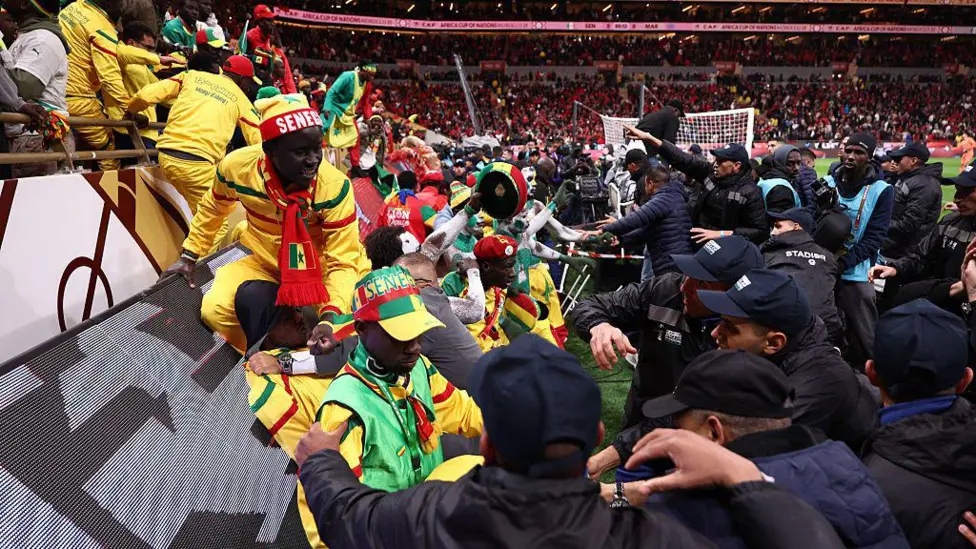
March 17, 2026, was set to be a night of Champions League drama. Chelsea and Manchester City were both chasing comebacks after heavy first-leg defeats to PSG and Real Madrid. Instead, both faltered again, leaving fans frustrated and pundits scribbling hot takes. What should have sparked endless debate and social media bants, however, was abruptly overshadowed, not by a footballing twist, but by a statement from the Confederation of African Football (CAF) that tore through the internet.
Before diving in, let’s rewind to 2021. Jurgen Klopp famously described the Africa Cup of Nations as a “little tournament,” a remark that raised eyebrows at the time.
He was facing the reality of losing Mohamed Salah and Sadio Mané to the competition in January–February 2022. Klopp defended the comment, calling it “ironic,” but for many, the wording landed poorly. Fans and pundits alike bristled—“little tournament” was a phrase that didn’t sit right.
Fast forward to February 2025. Jamie Carragher was dissecting Salah’s chances of winning the Ballon d’Or on Sky Sports. He argued that Salah wasn’t competing in a “major tournament.” Micah Richards and Daniel Sturridge interjected, pointing to the AFCON, but his body language still downplayed its significance.
Now back to the statement that tore through the internet. CAF announced last night that Morocco are the 2025 Africa Cup of Nations winners, 57 days after the final, as Senegal’s 1–0 victory was declared void. Strange, right?
The statement reads:
CAF’s appeal board concluded that Senegal’s actions violated the tournament’s rules. According to the board, the team breached Articles 82 and 84 of the AFCON regulation.
What Do the Rules Say?
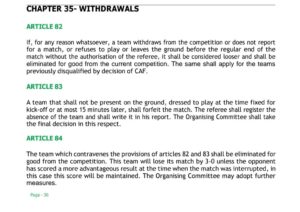
Article 82 makes it clear that any side leaving the pitch before the match has officially ended, without the referee’s permission, must forfeit the game.
Article 84 subsequently states that the forfeiting team will be ruled to have lost the match 3-0, unless the opponent was leading by a more advantageous result.
Is CAF Correct in Their Ruling?
On January 28, the CAF Disciplinary board rejected the protest lodged by the Fédération Royale Marocaine de Football (FRMF) regarding alleged violations by the Fédération Sénégalaise de Football (FSF) of Articles 82 and 84 of the Regulations of the Africa Cup of Nations, relating to the AFCON 2025 Final.
Morocco approached the appeal board, which has now issued a verdict overturning Senegal’s status as champions.
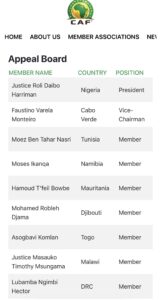
But is their ruling correct? It’s not an easy question to answer. This case falls squarely within law and regulations, so simply saying the board is wrong isn’t really applicable, especially when the panel is led by Justice Roli Daibo Harriman, a prominent Nigerian jurist. She is well known for her work in the Delta State High Court and in international sports law, and was elected to the CAF appeal board at the general assembly in 2023.
But another Legal Practitioner from Nigeria, Nna Henry said CAF is not correct in their ruling. He said ;
“ No, CAF is not correct
They are interpreting law and the equitable maxim “qui approbat non reprobat” does not support this judgement.
Once Morocco agreed to continue the match, they waved their right.”
An interesting take there is that by continuing to play, Morocco may have waived their rights in the moment. Many have even said that the law should have been applied right there on the pitch during the final.
Maybe, Just Maybe…
Now let’s look at the interesting side of the situation. This is a chaotic chain of events, and the fallout is far from straightforward.
Throughout the tournament, many observers and viewers felt that CAF were doing everything possible to ensure Morocco won the AFCON, benefiting from several refereeing decisions in their favor.
In their round of 16 game, many argued that Tanzania should have had a penalty situation reviewed, but nothing was done. In the quarter-final against Cameroon, there were a few questionable incidents. No penalty was awarded for a foul on Bryan Mbeumo in the box, and an elbow on Karl Etta Eyong was ignored.
Against Nigeria in the semi-final, a couple of Nigerian players, Samuel Osayi Samuel and Akor Adams, raised concerns about the referee. In the final, Senegal had a goal disallowed just moments before Morocco were awarded a penalty, a scenario that prompted angry reactions from Senegalese fans in the stands.
Many already harbor a certain animosity toward Morocco, feeling that CAF is playing to political pressures and that there is a sense of desperation to secure a win. The CAF Awards sparked this conversation, and the AFCON itself only amplified it.
But amid all the criticism CAF is facing, and as I don’t yet have a standard interpretation of the rules and laws, I still need to understand why Morocco’s punishment, as handed down by the disciplinary board, was reduced.
Which laws, articles, or regulations support the reduction of fines in the Morocco-related incidents, specifically the Saibari case, the ball boys situation, and the use of lasers?
Saibari’s three-match ban has been reduced to two games, with one suspended, while his $100,000 fine has been wiped. The initial fine of $200,000 for the inappropriate behaviour of the stadium ball boys has been reduced to $50,000. The initial $15,000 fine for the use of lasers by supporters has been reduced to $10,000.
Which laws, articles, or rule books justify these reductions? It’s a question that cuts to the heart of CAF’s credibility. For many, the governing body has long been viewed less as a custodian of the game and more as an institution mired in corruption, its integrity taken for granted or outright doubted.
Senegal still has the option to take the case to the Court of Arbitration for Sport, CAS. But the mess surrounding this situation is immense, and the conversations will linger for long.
Jamie Carragher even put out a smug tweet, one that, in context, might as well read: “I told you so,” in his argument that the AFCON isn’t a major tournament.
And just as Carragher and some others may feel, maybe, just maybe, AFCON is a little tournament after all. CAF, its governing body, seems determined to make sure it feels like one, with all this drama. Self sabotage.




This article has just supported my thoughts on this matters, your insights and explanations will help many ro understand the extent of this problem. Just as you write all the actions of CAF pointing to Morocco favour and because they refused to host the wafcon they’re now doind everything to a peace thwm. Let’s wait for the final CAS verdict.