

It is my seventh day in Morocco, and my sixth in the cold city of Fes. In that short time, a few small experiences have begun to stitch themselves into something bigger.
When some of the locals see us and we say, Nigerians, and mention that we are here for the Coupe d’Afrique, the Africa Cup of Nations, many of them react with sudden excitement. Some immediately start chanting. A few smile and say names that have lived long in African memory: Jay-Jay Okocha, Kanu Nwankwo. One even mentioned Babangida, a name from outside sport entirely, which somehow felt just as fitting.
Before Nigeria’s opening game against Tanzania on Tuesday evening, the same thing kept happening. Whenever the Moroccans I met asked me if I am in Morocco as a Nigerian, they almost instinctively pitched their tent with us. I do not fully know why. But one thing I do know is that historically Nigeria has given Africa superstars across football and other sports. Players and personalities many Africans have grown up with, copied, argued over, admired. Nigeria has long been known as a footballing nation, and perhaps that reputation still travels quietly from generation to generation.
The support I saw on the streets of Fes before kick-off, however, was little compared to what unfolded inside the stadium.
The Elegbete TV crew were on the ground taking fans’ reactions, and several Moroccan supporters openly pledged their support for Nigeria. What had been intriguing from observation before the match became something else entirely once the game began.

Nigeria dominated large parts of the first half. Then, four minutes before the opening goal, around the 32nd minute, the first great moment of the night arrived. Chants of “Ole, Ole” rolled across the stadium. It was not only Nigerians singing. Moroccan fans were on their feet too, jumping and chanting in the rain, their voices merging into one long echo of support. It was impossible not to feel it. The sound was warm. The moment was alive.
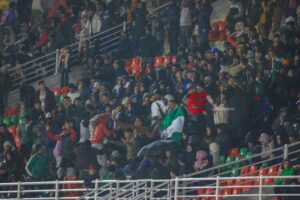
But the most striking scene came later.
In the 68th minute, high in the stands, Moroccan fans began a call-and-response chant that cut clean through the noise:
“Victor… Osimhen.”
Again and again. Loud. Proud. Personal.
This was no longer about the team alone. This was about one man, one African footballer whose story and spirit have travelled far beyond borders. It felt like it was his own nation fans chanting his name, A Nigerian striker being sung into the night by Moroccan voices in the middle of an AFCON match, and in that moment, it felt entirely natural.
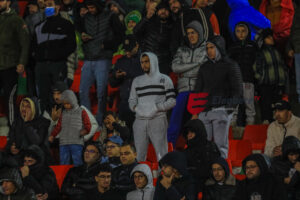
That is why the night felt bigger than football.
Because for a few hours in Fes, it stopped being about nations, flags or even the scoreboard. It became about shared memory, shared respect, and a shared love for the game and the players who give it meaning.
Those are the nights African football gives you when you are lucky enough to be inside the stadium.


